
How Much Does Shockwave Therapy Cost at a Chiropractor?
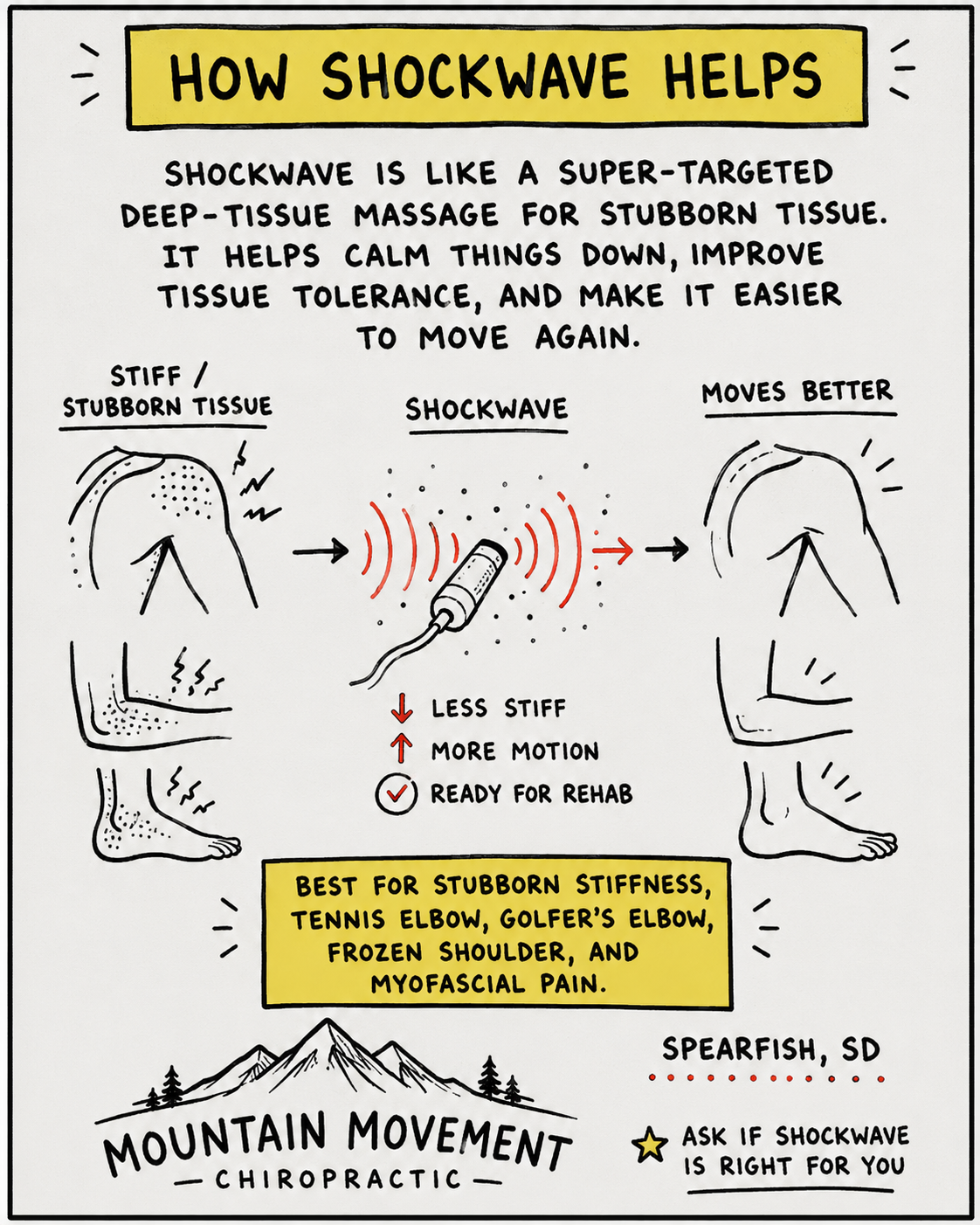
Shockwave therapy has become one of the most talked-about treatments for stubborn muscle, tendon, and joint problems. Patients hear about it helping plantar fasciitis, tennis elbow, golfer’s elbow, frozen shoulder, chronic stiffness, and other nagging issues that just do not seem to go away. Naturally, one of the first questions people ask is, “How much does shockwave therapy cost at a chiropractor?”
At Mountain Movement Chiropractic, we do things a little differently. We use shockwave therapy alongside chiropractic adjustments, soft tissue care, and therapeutic exercise when it is clinically needed. For patients using ChiroHealthUSA, shockwave is included in our $60 daily visit price, which makes it an extremely high-value option for care.
What Is Shockwave Therapy?
Shockwave therapy uses acoustic pressure waves to stimulate irritated or restricted tissue. It is often used for tendon problems, chronic stiffness, myofascial pain, and areas that have not responded well to rest, stretching, or basic rehab.
In our office, I often describe shockwave as a super targeted deep tissue massage. It gets into stubborn tissue in a way that hands alone sometimes cannot. The goal is not just to make something feel better for a few minutes. The goal is to help the tissue become more tolerant to movement so we can restore function.
How Much Does Shockwave Therapy Cost at Mountain Movement Chiropractic?
At Mountain Movement Chiropractic, shockwave therapy is included when clinically needed for patients using ChiroHealthUSA. That means if you are a ChiroHealthUSA patient, your daily visit is $60, and shockwave is included in that visit when it is appropriate for your condition.
For insurance patients, shockwave therapy is an additional $20 because Blue Cross Blue Shield does not cover it. This keeps the pricing clear and simple. You know what it costs before treatment starts, and there are no surprise shockwave bills later.
This is one of the reasons we brought on ChiroHealthUSA. Our goal is to make care more affordable and more transparent for patients who want results without confusion. You can learn more about our pricing structure on our FAQ and pricing page.
Why Our Pricing Is Different
At many clinics, shockwave therapy may be billed as a separate service every time it is used. That can make care expensive quickly, especially when multiple sessions are needed. At Mountain Movement Chiropractic, we use shockwave as part of the overall treatment plan rather than treating it like a standalone luxury add-on.
When it is clinically appropriate, it becomes one of the tools we use to help you get better. That may also include chiropractic adjustments, therapeutic exercise, soft tissue work, and movement coaching.
The value comes from combining these services intelligently. Shockwave works beautifully with an adjustment because the adjustment helps restore motion, while shockwave helps reduce tissue sensitivity and improve tolerance to movement. Then exercise helps keep the improvement going.
How Many Shockwave Sessions Do Most People Need?
The therapeutic dose for shockwave is usually between 3 and 6 visits. Some patients feel an immediate change after the first session. Others notice gradual improvement over the course of several visits.
In general, the faster a condition comes on, the faster it tends to improve. A newer tendon or muscle irritation may respond quickly. A chronic issue that has been around for months or years usually takes more consistency.
This is why we do not think of shockwave as a one-time miracle treatment. It can be extremely effective, but it works best as part of a plan. Our Mountain Movement Approach is built around getting patients out of pain, restoring function, and helping them sustain their results long term.
What Conditions Do We Use Shockwave For?
We use shockwave therapy often for tennis elbow, golfer’s elbow, frozen shoulder, myofascial pain syndrome, chronic stiffness, and stubborn extremity issues. It works especially well on areas like elbows, shoulders, knees, ankles, and feet because those tissues often respond well to targeted mechanical stimulation.
Shockwave therapy has been studied for a variety of tendon-related conditions. A systematic review and meta-analysis on tendinopathies looked at how extracorporeal shockwave therapy affects pain in different tendon problems. Other research has looked specifically at shockwave therapy for Achilles tendinopathy, which is another common stubborn tendon condition.
In our office, the biggest wins often come from patients who feel like they have tried everything. These are the people who have stretched, rested, used braces, tried massage, changed activities, and still feel stuck. When the right tissue is treated and the plan is followed, shockwave can help patients regain motion and confidence.
Why Shockwave Works Best With Chiropractic Care
Shockwave therapy is not meant to replace a good exam, a specific adjustment, or therapeutic exercise. It works best when we know exactly what tissue is limiting your motion or keeping your pain cycle going.
For example, if someone has golfer’s elbow, the irritated tissue may be part of the problem, but their shoulder, neck, grip mechanics, or overall movement pattern may also be contributing. If we only treat the painful spot, the relief may not last.
That is why we look at the whole person. At Mountain Movement Chiropractic, we want to know why the tissue got irritated in the first place. Shockwave helps us calm down stubborn tissue, but the adjustment and exercises help change the mechanics that caused the issue.
Shockwave for Frozen Shoulder and Stiff Joints
Frozen shoulder is one of the conditions where shockwave can be especially exciting. Frozen shoulder, also called adhesive capsulitis, causes pain and progressive loss of shoulder motion. The American Academy of Orthopaedic Surgeons also describes frozen shoulder as a condition involving pain and stiffness that can make normal shoulder movement difficult.
In our clinic, patients with stiff shoulders often notice that shockwave helps the joint feel less guarded and more willing to move. It works beautifully when paired with the adjustment and targeted movement work. You can read more about similar treatment tools we use in our dry needling blog.
Why Earlier Treatment Is Usually Better
The earlier you address a condition, the better. When pain has only been present for a short time, the body usually responds faster because the movement pattern has not been reinforced for months or years.
When a condition becomes chronic, tissues can become more sensitive, joints can lose motion, and the body may build compensation patterns around the pain. Shockwave can still help chronic cases, but they usually require more consistency.
Mayo Clinic explains that treatment for frozen shoulder commonly focuses on preserving and restoring range of motion. That fits how we think about shockwave in the clinic. It is not just about pain relief. It is about helping the body move again.
What Does the Research Say?
Shockwave therapy has been studied for several musculoskeletal conditions, especially tendon-related pain and frozen shoulder. One review looked at shockwave therapy as an adjunctive therapy for frozen shoulder, meaning it may be helpful when used alongside other treatments rather than as the only tool.
The research is not saying shockwave is magic or that it works for every person every time. What it does support is that shockwave can be a useful tool for certain tendon, soft tissue, and stiff joint problems when combined with good clinical reasoning and an active plan.
That is how we use it at Mountain Movement Chiropractic. It is not the whole plan. It is one high-value tool inside a complete plan.
Is Shockwave Therapy Worth the Cost?
For many patients, yes. Especially when it is included in a $60 ChiroHealthUSA daily visit when clinically needed, the value is hard to beat. You are not just paying for a device. You are paying for an evaluation, clinical decision-making, chiropractic care, movement guidance, and the right tools used at the right time.
If you are dealing with a stubborn condition that has not responded to stretching, rest, or basic care, shockwave therapy may help move the needle. It may also help you avoid spending more money later on repeated appointments, injections, imaging, or other interventions that may not address the underlying movement issue.
If you are curious whether shockwave therapy is right for your specific condition, the best place to start is a proper exam. You can also visit our services page to better understand the tools we use.
Simple, Transparent, High-Value Care
Shockwave therapy can be expensive at some clinics, but it does not have to be confusing. At Mountain Movement Chiropractic, ChiroHealthUSA patients receive shockwave as part of the $60 daily visit when it is clinically needed. Insurance patients pay an additional $20 because it is not covered by Blue Cross Blue Shield.
Our goal is simple. We want to provide effective, affordable care that helps you move better, feel better, and get back to doing the things you love.
📍 Mountain Movement Chiropractic – Spearfish, SD
📅 Schedule an Appointment Today!